
.svg)
.svg)
Key Takeaways
- The 2017 Elephant Hills Wildfire near Ashcroft, British Columbia, burned approximately 192,000 hectares over 75 days, making it one of the most significant wildfire events in the province’s history.
- Forsite was engaged by the Province of BC through the Forest Carbon Initiative to manage post-wildfire silviculture activities.
- Working with the Thompson Rivers Natural Resources Region, Forsite delivered a full suite of services, including aerial reconnaissance, surveys, planting prescriptions, contractor tendering, implementation, and survival monitoring.
- Forsite developed the Natural Regeneration Matrix to prioritize survey and planting efforts based on stand and ecological characteristics.
- The matrix was later adopted into provincial post-wildfire guidance and helped determine which areas would regenerate naturally versus which required active intervention.
- Ongoing surveys continue to improve understanding of wildfire recovery, especially in areas affected by lower fire intensity and differing vegetation responses.
- Forsite continues to play a long-term role in adaptive post-wildfire recovery and reforestation planning.
A Historic Burn at the Time
The Elephant Hills Wildfire near Ashcroft, British Columbia, grew to an incredible 192,000 hectares over the course of 75 days, burning from early July to late September of 2017.
Compare this to the previous significant wildfire seasons in 2003, when the McLure fire near Barriere and the Okanagan Mountain Park fire near Kelowna both reached approximately 26,000 hectares. Since Elephant Hills, the major 2021 wildfire season saw fires such as Lytton Creek and White Rock Lake reach approximately 83,000 hectares, while Sparks Lake burned roughly 96,000 hectares.
Pre-fire Conditions
2017 was an unusual year, marked by one of the wettest springs on record. At first glance, this seems counterintuitive given that the largest fire in the history of the Thompson Okanagan Natural Resource Region followed such wet conditions. Snowpacks were so high that when they melted, widespread road washouts occurred, putting communities throughout the region at risk.
Silviculturists typically expect rainfall in late May and early June, along with cooler weather. In most years, this weather pattern is dependable enough to be known informally as “June-uary.” In 2017, however, this mid-spring rain event did not arrive. Soil moisture continued to decline throughout May, June, August, and into September without meaningful rainfall.
The wet spring also caused native grass species to grow unusually tall, creating a significant fuel hazard. The wildfire began in the grasslands and expanded rapidly into the dry interior Douglas-fir forests. In that way, one of the wettest springs in recent memory helped create the conditions for one of the largest wildfire seasons on record.
Proactive Planning
Forsite was engaged by the Province of BC to manage the silviculture activities associated with the fire through Forest Carbon Initiative funding. Communications were coordinated by the Thompson Rivers Natural Resources Region among stakeholders across the affected area. Activities funded through the province included helicopter reconnaissance, surveys, planting prescriptions, planting planning, tendering contracts to tree planters, implementation of planting programs, and follow-up survival surveys.
Forsite has a long history of silviculture surveying in and around the Elephant Hills fire area. The team’s intimate knowledge of the land base proved critical to decision-making during and after the fire.
Forsite also conceived and developed the Natural Regeneration Matrix to prioritize post-fire survey and planting efforts. This matrix was later adopted into the province’s guidance for post-wildfire reconnaissance, survey reporting, and treatment prescription development.
The tool triaged stand types and ecological conditions to determine which areas were likely to regenerate naturally and which were likely to remain without young conifers.
Within the first year after the 2017 fire, Forsite’s team observed significant variation in the response of competing vegetation, particularly pinegrass. Early efforts focused on surveying and reforesting sites where poor natural regeneration was expected. Today, ongoing surveys continue to build understanding of how natural regeneration responds after wildfire and help refine the matrix over time.
Natural Regeneration Decision Matrix
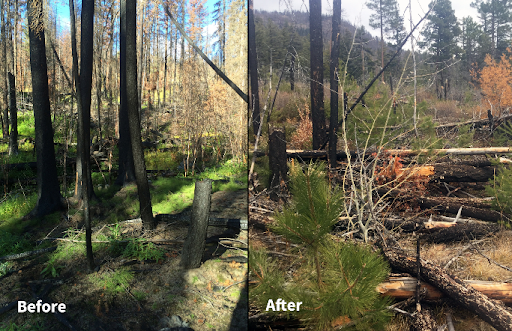
This photo shows how intense the fire was wherever the fuel load was significant. This stand has approximately 4–8 years before pinegrass mats fully develop, and the overstory will begin to come down in 7–12 years. These stands should be prioritized early to take advantage of the remaining shade for new seedlings.
Older Stand Recovery
Older stands, including those with large volumes of mature timber before the fire, showed a noticeably delayed response in competing vegetation. These forests and plantations experienced both high fire intensity, meaning a large number of trees were killed, and high burn severity, meaning the fire burned deeply into the soil.
Pinegrass regrowth in these stands was weak and scattered. It appeared to be growing primarily from wind-dispersed seed, suggesting that existing root systems had been killed by the fire’s depth and severity. Because of this intense burn severity, these stands offered an extended window for reforestation through underplanting without mechanical site preparation. These conditions also allowed for a substantially higher proportion of Douglas-fir in planting treatments.
Douglas-fir survival in the 2019 and 2020 planting years was excellent, averaging 90 percent survival. Survival in later plantations has declined somewhat, largely due to increased pinegrass competition and the gradual loss of shade as the dead overstory collapses.
Younger Stand Recovery
Younger plantations that burned showed an immediate pinegrass response that competed directly with planted trees, particularly Douglas-fir seedlings. These sites generally experienced high fire intensity in terms of tree mortality, but lower burn severity in terms of soil heating and below-ground damage.
The pinegrass response appeared to be driven largely by regrowth from plants already present before the fire. In effect, the fire increased competition rather than resetting it. These younger stands did not burn as hot because their fuel loads were lower.
Forsite continues to monitor vegetation competition closely on these sites. In many cases, mechanical site preparation such as disc trenching, excavator screefing, or ripper plow treatments may be necessary. These interventions can be essential for seedling survival where vegetation competition has become extreme.

This photo shows a fairly typical range of fire intensities and implied burn severities. This older forest burned very hot, killing all of the trees and consuming the needles, cones, and seed bank. Near the creek running through the middle of the stand, the fire burned at lower intensity; the trees died, but the needles remained. A common trend was that younger plantations either did not burn at all or burned only where they bordered larger fuel loads in adjacent mature forest. Where younger plantations did burn, fire intensity was often light, with 20–80 percent tree mortality, or moderate, where all trees died but needles, cones, and seed remained. These younger stands are often more difficult to reforest because competing pinegrass rebounds quickly.
Replanting
The success of underplanting into severely burned stands aligns with the findings of the 2019 report Reforesting Dry Sites in the Thompson Okanagan Natural Resource Region. One clear trend on extremely dry and very dry sites was that the success of planting treatments depended primarily on disturbance intensity and the presence of shade, among other secondary factors.
The 2017 drought caused significant tree mortality throughout the Thompson Okanagan Region. During this drought year, trees planted into highly disturbed microsites such as burn piles and road rehabilitation areas survived well. Trees planted into mechanically prepared areas survived only where the soil disturbance was most significant. Raw planting and weaker site preparation treatments saw widespread mortality.
These findings matched Forsite’s observations in the Elephant Hills fire area. The most successful planting treatments occurred in stands that combined high burn severity, where the fire burned deeply enough to affect competing roots, with the retention of dead conifers that continued to provide shade. This combination reduced pinegrass competition and protected young seedlings from extreme sun exposure.
Reforesting Dry Sites in the Thompson Okanagan Natural Resource Region. Colin Hegan – Forsite.
What’s Next?
Lessons from the 2017 Elephant Hills fire, along with other wildfires in the region, continue to shape recovery efforts following the severe 2021 wildfire season. Silviculture specialists such as Forsite’s Colin Hegan, RPF, continue to develop drought-resistant stand strategies and refined procedures for reforesting dry sites. Colin also completed a review of underplanting over the previous 15 years to support decision-making across the province’s broader reforestation efforts.
Forsite fire behavior specialists believe fire hazard is relatively low in previously burned stands, reducing risk to newly planted trees. Planting high-quality seedlings in strategic locations before the overstory collapses remains one of the best ways to create safer working environments for planters while minimizing seedling mortality.
As fire seasons continue and post-wildfire recovery tools evolve, Forsite remains committed to learning, adapting, and improving restoration outcomes across affected land bases.
Conclusion
The Elephant Hills Wildfire was a defining event in British Columbia’s wildfire history, and the recovery effort that followed has been equally significant. Through proactive planning, innovative tools like the Natural Regeneration Matrix, and years of adaptive monitoring, Forsite’s work in the region has not only helped restore this forested landscape but has also influenced how the province approaches post-wildfire reforestation more broadly.
The lessons learned about burn severity, competing vegetation, shade, and seedling survival continue to inform recovery efforts from later fire seasons, including the devastating 2021 fires. Post-wildfire reforestation is a long-term process, and Forsite remains committed to supporting that work with practical expertise and site-specific insight.
Want to learn how Forsite can strengthen your utility's wildfire risk management program?
FAQ
What was the Natural Regeneration Matrix and why does it matter?
The Natural Regeneration Matrix is a triage tool developed by Forsite to assess whether burned stands are likely to regenerate naturally or require intervention. It evaluates factors such as fire severity, seed-in potential, aspect, brush hazard, and soil moisture to help prioritize planting where it is most needed. It was later adopted into provincial post-wildfire guidance in British Columbia.
Why did the 2017 fire burn so large despite a record wet spring?
The unusually wet spring caused native grasses to grow exceptionally tall, creating heavy fuel loads. When the expected late May and June rains never arrived, soil moisture dropped steadily through the summer with no meaningful relief. The result was a landscape primed to burn, beginning in the grasslands and spreading rapidly into dry interior Douglas-fir forests.
What species were prioritized for replanting, and why?
Douglas-fir was significantly increased as a proportion of planting treatments, particularly in older, severely burned stands. Its survival rates averaged 90 percent in the 2019 and 2020 planting years, largely because deep burn severity reduced competition and retained dead overstory helped provide shade.
Why do older and younger burned stands require different approaches?
Older stands tended to burn intensely and deeply, killing pinegrass roots and delaying regrowth of competing vegetation. This created a larger window for successful underplanting without mechanical site preparation. Younger plantations often burned less severely, which allowed pinegrass to rebound quickly from surviving root systems. As a result, those sites often require more intensive competition management and mechanical site preparation.
Is mechanical site preparation always necessary?
Not always. In older, severely burned stands, deep burn severity combined with overhead shade from dead trees reduced the need for mechanical preparation and supported strong seedling survival. In younger stands with aggressive vegetation regrowth, however, treatments such as disc trenching, excavator screefing, or ripper plowing are often necessary to improve establishment success.
How can Forsite support post-wildfire recovery projects?
Forsite provides full-phase silviculture and reforestation services, from reconnaissance and survey design to treatment implementation and long-term monitoring. This helps land managers make informed, site-specific decisions that improve regeneration outcomes after wildfire.
.avif)
.png)